Artist Profile
Review by Emma Walker
Issue No. 73 | nov. 2025
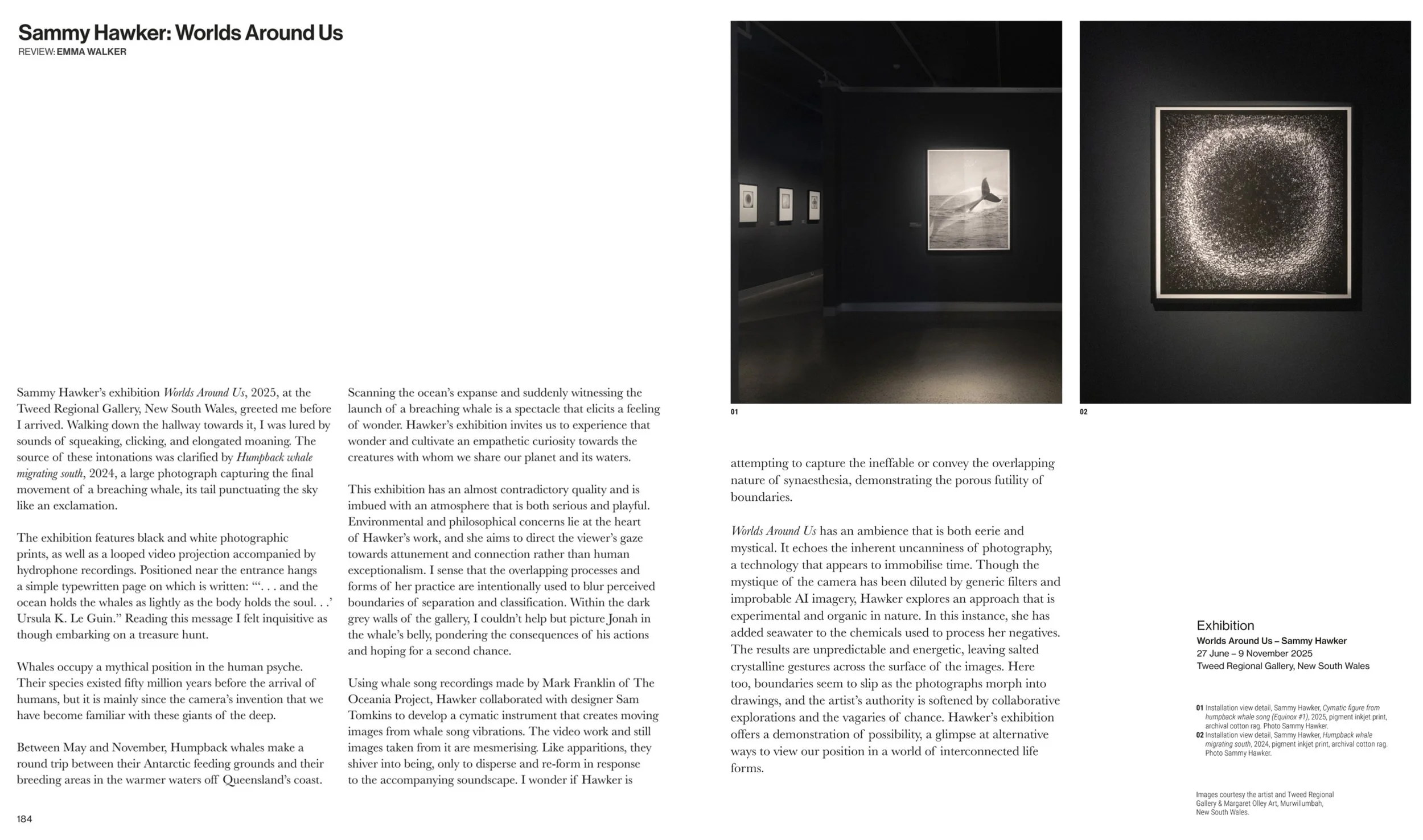
Worlds Around Us | Tweed Regional Gallery | 27 jun. — 9 nov. 2025
Sammy Hawker's exhibition Worlds Around Us, 2025, at the Tweed Regional Gallery, New South Wales, greeted me before I arrived. Walking down the hallway towards it, I was lured by sounds of squeaking, clicking, and elongated moaning. The source of these intonations was clarified by Humpback whale migrating south, 2024, a large photograph capturing the final movement of a breaching whale, its tail punctuating the sky like an exclamation.
The exhibition features black and white photographic prints, as well as a looped video projection accompanied by hydrophone recordings. Positioned near the entrance hangs a simple typewritten page on which is written: "... and the ocean holds the whales as lightly as the body holds the soul…Ursula K. Le Guin." Reading this message I felt inquisitive as though embarking on a treasure hunt.
Whales occupy a mythical position in the human psyche. Their species existed fifty million years before the arrival of humans, but it is mainly since the camera's invention that we have become familiar with these giants of the deep. Between May and November, Humpback whales make a round trip between their Antarctic feeding grounds and their breeding areas in the warmer waters off Queensland's coast.
Scanning the ocean's expanse and suddenly witnessing the launch of a breaching whale is a spectacle that elicits a feeling of wonder. Hawker's exhibition invites us to experience that wonder and cultivate an empathetic curiosity towards the creatures with whom we share our planet and its waters. This exhibition has an almost contradictory quality and is imbued with an atmosphere that is both serious and playful.
Environmental and philosophical concerns lie at the heart of Hawker's work, and she aims to direct the viewer's gaze towards attunement and connection rather than human exceptionalism. I sense that the overlapping processes and forms of her practice are intentionally used to blur perceived boundaries of separation and classification. Within the dark grey walls of the gallery, I couldn't help but picture Jonah in the whale's belly, pondering the consequences of his actions and hoping for a second chance.
Using whale song recordings made by Mark Franklin of The Oceania Project, Hawker collaborated with designer Sam Tomkins to develop a cymatic instrument that creates moving images from whale song vibrations. The video work and still images taken from it are mesmerising. Like apparitions, they shiver into being, only to disperse and re-form in response to the accompanying soundscape. I wonder if Hawker is attempting to capture the ineffable or convey the overlapping nature of synaesthesia, demonstrating the porous futility of boundaries.
Worlds Around Us has an ambience that is both eerie and mystical. It echoes the inherent uncanniness of photography, a technology that appears to immobilise time. Though the mystique of the camera has been diluted by generic filters and improbable Al imagery, Hawker explores an approach that is experimental and organic in nature. In this instance, she has added seawater to the chemicals used to process her negatives.
The results are unpredictable and energetic, leaving salted crystalline gestures across the surface of the images. Here too, boundaries seem to slip as the photographs morph into drawings, and the artist's authority is softened by collaborative explorations and the vagaries of chance. Hawker's exhibition offers a demonstration of possibility, a glimpse at alternative ways to view our position in a world of interconnected life forms. — review by Emma Walker.
Copyright © All rights reserved.